children are resilient.

children are resilient.

The Merriam-Webster dictionary defines resilience as an ability to recover from or adjust easily to misfortune or change.

I recently completed a college childhood development course covering birth to adolescence. It was fascinating to learn the physical development of the brain throughout each stage of life and what components are responsible for various functions.

This was not only about physical milestones. It covered emotional and mental development and how children are able (or unable) to accomplish specific objectives. One reason more than ever I love working with middle school students is because I now have a greater understanding of what children mentally or emotionally can or cannot accomplish. When I help my students, in a way, I am helping my 13 something year old self.

The college text I used did not reveal any biases in terms of heavily liberal or conservative ideologies. Facts were presented with various childhood development theories (can I say here that I think Sigmund Freud was out of his mind?). Science and medicine is an ongoing process. There will always be questions, hypotheses, experiments, and observations. Always.

One statement in my textbook stood out to me: children are resilient.

It resonated with me deeply because when I consider some of the painful situations I experienced as a child, it is amazing to me that I emotionally survived it. There were some serious situations that could have should have not happened. But they did. Certainly my faith throughout the years has been significant in helping me resolve the damage. Some unbelievers might argue differently. But will they argue with a NY state college textbook?

When you are involved in a church for decades, you hear many biblical promises that easily can become catch phrases such expecting “cheerful obedience” from your child. That sort of lines up with children should be seen and not heard and as my textbook says, an authoritarian parenting style. This is the mindset of expecting behavior that the child is not able to do. Would we expect a 3 month old to walk? But we expect (and even demand) a 13 year old to “straighten up and fly right” (which ironically, is a catch phrase from my parent’s generation from a Nat King Cole song). Perhaps one of the books a first time parent should read is one outlining childhood brain development. It would be beneficial, especially during the adolescent years. While children are resilient, wouldn’t we want all of the information to best serve them? Resiliency certainly isn’t an excuse to be neglectful.

We all have our stories. Some have situations worse than others. But we are who we are and pain is pain and how we interpret it as children (or adults for that matter) needs to be validated. Sometimes that is all a child or adult needs. Ackowledgment. Admission. You weren’t crazy. I did this. And getting an apology is nice but that may not happen.

We live in a time when understanding human behavior and conditions is at the forefront. The availablity of the internet with all of the podcasts, online articles, and Youtube, abound. We get to hear what everyone thinks about any given topic. Anyone and everyone can chime in with opinions. As is typical, whenever a new way of thinking or doing happens, it is easy to jump on the bandwagon. This is being human. And the Christian is not immune. Even in Christian circles it happens when one navigates toward a particular scripture that resonates with them and they build their life on it (e.g. faith movement).

One hot topic today is adult children crying foul because of their childhood. There are severe cases of abuse and I am not dismissing that. In fact, God has something to say about hurting children:

It would be better to be thrown into the sea with a millstone hung around your neck than to cause one of these little ones to stumble.

There is a tendency for us to go too far with anything until we should find balance. Inflciting pain upon a parent with boundaries (e.g. not talking to them, withholding grandchildren, etc.) because they are “toxic” might be just as bad as you being toxic to them. Again, there are valid reasons and I will not judge those reasons. But certainly, because we are capable of chasing the shiny objects of new trends, we should contemplate some deep questions. We are living in a time when people want to feel better and maybe the focus can become too self centered at times.

For the Christian, we carry a responsibility. When we say we are “in the world but not of it”, it means we have the ability to live free from the weight of human emotions of bitterness, anger, resentment, lust, etc. When the Apostle Paul asked God to remove the “thorn in the flesh” (something that was difficult), God said: “My grace is enough for you, for my power is made perfect in weakness.” This wasn’t some dry commandment to obey. God didn’t say, “Straighten up and fly right, Paul”. He offered freedom for Paul telling him what was in him to overcome. There is a mysterious transfer of our mind, will, and emotions that occurs when we do it God’s way. And Paul had to agree with it for it to happen.

But even if we don’t agree, in God’s goodness to humanity, he has wired us to overcome much. There is a reason why memes such as, “You got this” and “I believe in you” resonate with us.

Children are no different. They, too, are wired to be resilient.

God promises that there will be a day when he will wipe away every tear of our pain and suffering. We can gain inspiration from my favorite chapter in the Bible, Hebrews 11. We are surrounded by a great cloud of men and women who went before us, endured pain and suffering without understanding why, because of the hope God put in them and in us.

Photo by Juan Pablo Serrano on Pexels.com

context.

context.

I had a thought this morning.

We are not all okay.

In other words, we think this person or that person is doing well because they look happy.

Not true.

Everyone of us have something on our minds. A place in our hearts or minds that have this empty space of disappointment, sadness, loss.

Then I began to think about people who lived throughout the centuries and what kind of life they had. Particularly, I thought about the pioneers who explored and the settlers who settled. The day to day, mundane, unpredictable existence they experienced.

Their world view was limited. Each day they had purpose and found a life of contentment in what they did. How do I know this? Because it’s in all of us. The ability to be content in undesirable situations. God created us and he put it in us. Some call it human potential or resiliency because you don’t have to be a Christian to have it. Most of us have the ability to get up, brush ourselves off, and keep going.

Fast forward to 2025. Look at all we have. Now compare yourself to them.

Are we any different? Obviously, we have amazing advancements in medicine and technology. And certainly, that has impacted our physical and mental compacity to not only have knowledge, but solutions, and the ability to exceed in ways that our predecessors never had.

Yet, inside, we are the same. We experience all of the emotions to life’s challenges.

That is context.

All of my life, I have taken a step back to consider the men and women who suffered throughout the centuries. It has given me inspiration, courage, and perseverance. What God has put in all of us can only be enhanced by knowing him through the promises of the scripture.

It reminds me of Hebrews 11, often referred as the faith chapter; a list of men and women who endured suffering. They endured because they saw things in context – that their suffering and ultimate death was not the end. They knew that God promised what was waiting for them in eternity.

Then Hebrews 12:1:

Therefore, since we are surrounded by such a great cloud of witnesses, let us throw off everything that hinders and the sin that so easily entangles. And let us run with perseverance the race marked out for us; fixing our eyes on Jesus, the pioneer and perfecter of faith. For the joy set before him he endured the cross, scorning its shame, and sat down at the right hand of the throne of God.

Not only does remembering the bigger picture step us out of our small thinking, exasperated by our tendency to be overly focused on ourselves, but it gives us the reason for context: there is an end to the story.

Get context.

optimism isn’t faith.

optimism isn’t faith.

“To choose to be optimistic or pessimistic is to set up a confirmation bias of your own mind to view the world the way you want it.”

-AzaRaskin

I am optimistic by nature. It’s natural for me to have hope and believe for the best.

My favorite chapter in the Bible has always been Hebrews 11, known as the faith chapter. I was inspired by these men and women of faith who believed. They resonated with my optimism and active lifestyle.

After the Jesus Movement of the 60’s, evangelical, charasmatic, and/or non-denominational churches sprung up everywhere. People wanted more of their church experience. Not to be entertained, but to know God in deeper and richer ways, understanding throughout the scripture that God wanted this, too.

Many of these churches emphasized faith and/or word-of-faith.

But faith can really be optimism and not faith at all.

Hebrews 11 lists the exploits of men and women who had faith. They were “history makers” and “moved mountains”… all the things you hear in many churches today. I think this resonates with our Western minds. Compared to other cultures, we excel at burning the candle at both ends.

But then, the end of Hebrews 11 says this:

“They were stoned, they were sawed in two, they were put to death by the sword. They went around in sheepskins and goatskins, destitute, oppressed, and mistreated. The world was not worthy of them. They wandered in deserts and mountains, and hid in caves and holes in the ground.

These were all commended for their faith, yet they did not receive what was promised. God had planned something better for us, so that together with us they would be made perfect.”

What? Why? Look at all they did for God. If this happened to them, could it happen to me? But what about all the promises found in the scripture of God’s protection, etc., etc.? What about the full armor of God? What about asking anything in Jesus’ Name?

Can our faith really be optimism viewing the world the way we want it?

When our world has been shattered, when it didn’t turn out the way we had prayed for, there is no optimism. Only pain and sorrow. But in the abyss, we can find real faith.

It’s not easy for Christians with the sword of the spirit in one hand and the shield of faith in the other hand to hear hard truths.

Faith isn’t based only on good outcomes. There is real suffering that goes on in the world and not everyone who prays in Jesus’ Name receives what they want or need.

If we say one day in His courtsis better than a thousand elsewhere, then perhaps one day in the abyss with God is better than anywhere else. Emmanuel, God with us, who promises never to leave us or forget us.

The abyss only reveals Him in the way you’ve wanted to know Him all along. The shadow that hid His face from you for so long is gone. You would never have seen Him completely had you not entered the abyss.

God sees the shattered pieces all around you and promises He will take care of that. If not here, the promise of eternity when He will wipe away every tear.

Amazing how the darkness can show us the true way.

suffering; part 2

suffering; part 2

I don’t believe we can endure suffering without resting our hope and faith in eternity with God.

At one time or another, all of us have questioned how a good God who is supposed to love us would allow suffering.

Thing is, we won’t get a satisfying answer. That’s because as advanced as we have become in areas such as technology, science, and medicine, we don’t understand everything.

Yet, we still seem to want and even demand to understand this. Even people who don’t believe in God are really recognizing his existence through rejecting him.

That’s because the Creator of the universe has written eternity on our hearts. In other words, whether you accept it or not, you can’t change it. It’s there.

When we accept suffering as a part of life, we learn to co-exist with it. We don’t accept it to the point of self deprivation or thinking embracing pain makes us more holier or acceptable to God.

Through faith, we trust God with it all, and find comfort in all his promises of being near us when we are in pain.

A child runs to a mother or father or any trusted caretaker for help and comfort. A picture of our Heavenly Father being there for us, too.

We’ve had our own personal experiences of suffering which can make us bitter and miserable if we cannot see beyond our life on earth. And often, when we get angry with God, we are only responding humanly to injustice. We don’t like to see people suffering.

God understand this. He created us to respond with compassion. We know how to help in many ways whether helping a neighbor who is suffering (from illness to the inability to shovel snow) or volunteering/contributing monetarily to a charity.

Yet, we are limited. In our own lives and the lives of others.

Consider this scripture found in the Bible:

How do you know what your life will be like tomorrow?

Your life is like the morning fog—it’s here a little while, then it’s gone.

Thankfully, most of us are not always thinking about this (I respectfully realize some suffer with fear). This is God’s design, too. We live life each day, our routines, and doing the next thing.

Even people who do not live as freely in some countries will tell you they have happiness. It may not look like yours or mine.

Throughout the centuries, people have looked ahead. I think suffering makes us do this. Like the adage says, “things will look better in the morning”, we are designed to hope in tomorrow. This is from God, too: Because of the LORD’s great love we are not consumed, for his compassions never fail. They are new every morning; great is your faithfulness.

I think one of the most inspiring times of suffering in American history is listening to the richness of the spiritual songs sung by plantation slaves of the Old South. Their suffering was immeasurable. Yet, I have read about an immeasurable strength in the midst of their pain.

Then, other times in American history of mothers and babies dying during childbirth, loved ones dying with illnesses and diseases we now have medicine for, young men as young as 16 going off to war and never experiencing a future.

Then, the Holocaust. I recently finished a book based on a true story, The Girl from the Channel Islands, about a Jewish girl trapped on the island of Jersey occupied by the Germans during WWII.

Consider this passage:

No fat reserves, she’d recenlty discovered, meant that sitting for long periods, even with a cushion, was a painful experience. She had spent the afternoon wandering aimlessly from room to empty room, searching for the balance between warming up and burning calories, but last night even climbing the stairs to the attic, had left her panting and dizzy, Her weakness frightened her …

… for seven days, they had between them two ounces of margarine, seven ounces of flour, three ounces of sugar, four ounces of meat … for a few moments they rejoiced as they devoured an acceptable lunch – perhaps a slice of tongue to go with a crust of tasteless Occupation bread.

Lastly, Hebrews 11, found in the Bible, records the heroes of faith. It begins with this:

Now faith is confidence in what we hope for and assurance about what we do not see. This is what the ancients were commended for.

People of faith who had amazing victories:

who through faith conquered kingdoms, administered justice, and gained what was promised; who shut the mouths of lions, quenched the fury of the flames, and escaped the edge of the sword; whose weakness was turned to strength; and who became powerful in battle and routed foreign armies. Women received back their dead, raised to life again.

Yet, at the end of the chapter:

There were others who were tortured, refusing to be released so that they might gain an even better resurrection. Some faced jeers and flogging, and even chains and imprisonment. They were put to death by stoning; they were sawed in two; they were killed by the sword. They went about in sheepskins and goatskins, destitute, persecuted and mistreated— the world was not worthy of them. They wandered in deserts and mountains, living in caves and in holes in the ground.

Not so victorious, were they? At least not our definition of victorious.

But God commends all of these people:

These were all commended for their faith, yet none of them received what had been promised, since God had planned something better for us so that only together with us would they be made perfect.

I have determined, only this satisifes the questions we have about suffering. We might call our perseverance the human spirit, but even that comes from God.

We don’t have all of the story now. We don’t have a complete explanation now.

But through faith, through trust, we believe.

He will wipe away every tear from their eyes, and death shall be no more,

neither shall there be mourning, nor crying, nor pain anymore, for the former things have passed away.

Photo by Pixabay on Pexels.com

do not despair.

do not despair.

The earth comes alive with fresh spring colors, celebrating rebirth.

Hidden eggs and colorful candy, butter yellow chicks and soft rabbits.

Cream colored lilies adorning churches.

Daffodils and tulips sway in the breeze.

Best Sunday dresses and ties to match.

Hymns and prayers, messages of hope.

Not everyone joins in the celebration.

A young mother is facing her fourth surgery today.

A family grieves the suicide of their loved one.

A couple have separated.

All around us, people are facing something.

Through faith men have conquered kingdoms

gained what was promised

and shut the mouths of lions.

Quenched flames 

escaped the edge of the sword

and women received their dead back to life again. 

But some did not.

There is suffering in life.

Repulsive, horrific, tragic, tormenting agony.

We question why? How can a “good” God allow such pain?

He did not remove it but God literally left his holiness and stepped into a world of corruption, depravity, and wickedness, in the human form of a man, to save it.

Perhaps it is because without the human form he would have obliterated earth entirely because of his holiness.

God wanted to show his love in a way we could understand. Jesus took on all of the depravity of mankind on the cross.

3 days later he came back to life, showing us He is God.

Who else would have power over death?

This is the hope of those who are happily celebrating today.

This is the hope of those who are not.

How is it that some get answers to prayers?

How is that some do not?

It’s easy to celebrate when there was a good outcome.

It is not easy to celebrate when there wasn’t.

Let’s remember

those who were all commended for their faith

yet none of them received what had been promised

since God had planned something better

so that only together with us would they be made perfect.

Hold onto that hope today.

God didn’t give to one and not to you.

God gives those who are suffering comfort and peace.

God sees.

God knows.

God is with you.

God promises that one day, he will make it right.

We are hard pressed on every side, but not crushed; perplexed, but not  persecuted, but not abandoned; struck down, but not destroyed. We always carry around in our body the death of Jesus, so that the life of Jesus may also be revealed in our body.

-The Bible

close up environment flora ground
Photo by David Alberto Carmona Coto on Pexels.com


where were the angels?

where were the angels?

Many of us believe in angels.

More commonly, angels intervening in a situation and saving someone from danger or death.

Car accidents, a house fire, or a bullet that just missed the heart, to name a few.

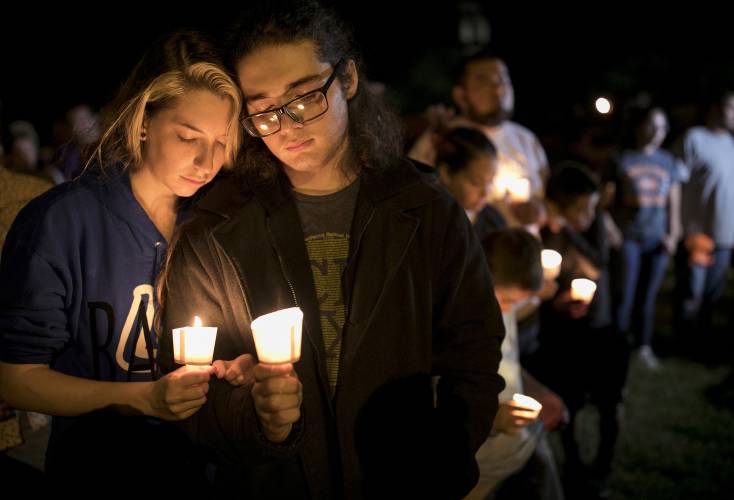
In the recent church shooting which murdered 27 people on a Sunday morning, at the First Baptist Church of Sutherland Springs, the question may arise, where were the angels?

The truth is, angels are not always protecting or saving people from death, are they? Which in turn, we equate God is not always protecting or saving people from death.

Otherwise, everyone, certainly the devoted Christian, would be protected.

At least that’s how our mind might work.

I have always felt badly for those left behind after a tragedy because the consensus of angels getting the credit for a miracle (sent by God, of course). It could make those who lost their loved one think they weren’t good enough, they didn’t pray enough, they didn’t have enough faith, or that God does not care about them or love them.

Those can be very painful thoughts. Thoughts that some carry throughout their lifetime.

Thoughts that are not true.

When I lost my oldest son at 24 years old, I wondered, where were the angels? 

Even though there will always be a part of my heart that feels like it is not beating, I had to come to terms with my faith or I would have wanted to die, too. A mother wants to know her kids are safe and where they are. When your child dies, no matter how old he or she is, you cannot fix it.  I was suspended in a place unknown and unfamiliar.

I had to figure some things out. If I had stayed focused with the lack of angelic protection for my son, I would have been miserable all these years. Faith is believing what you cannot tangibly see and I had to either believe God’s promises were true or not in order to go on.

Today more than ever, people “believe God” for healing and miracles. Sermons are preached of doing greater works than Jesus and  faith that moves mountains. People even pray for God to dispatch angels.

How did suffering people throughout the centuries view this message? What did they do when this was not so prevalent as it is today? People who did not have all the bells and whistles, entitlements, access to one-click purchases, retirement funds, and more?

I think they embraced what the bible says, they “longed for a better place, that is, a heavenly one”.

On a good day, do we long for that better place?

How about on a bad day?

I believe in prayer. I think we should pray for healing and miracles and everything else that is good. I don’t believe we should sit back and settle.

If we have attributed angelic intervention to our circumstances (ultimately God’s intervention), we have to remember others do not have this same experience.

What they do have is something else I believe is valid and important to understand. It is rarely not shared with the testimonies of answered prayer, especially those with the acknowledgment of angelic activity. I mean, who wants to say what is not so wonderful to hear? Give me the answered prayer. The miracle.

The angels.

Early on after Christopher’s death, I felt God in a way I had never felt before. Yes, I did stop eating on purpose. Yes, I did end up having anxiety attacks and needed medication.

But, God was showing me so much that brought comfort in a way that I think only those who have experienced immense suffering and grief understand.

Angels don’t just rescue us from physical danger.

They are sent by God as ministering spirits, just as God sent one to strengthen Jesus as he was suffering in the Garden of Gethsemane before the crucifixion.

Had I not walked through the Valley of the Shadow of Death, I would not have known what it was like to not fear. I would not have experienced the comfort of God’s rod and staff. I would not have gotten stronger without God leading me to green pastures and still waters and eventually, seeing my soul restored.

People who have been to this valley have seen God in a way others have not. In the bible, Job suffered unimaginably in this valley, and at the end he said, I’ve heard of You [God] but now my eyes have seen you. 

It is true, today, even the most devoted Christian can be caught up with here and now. God made us to live with eternity always within our view. When we don’t, we are missing something vital to the Christian life. Something that keeps us steady, anchored, and accepting of things gone wrong.

Living with an eternal view keeps things in perspective.

And perspective is exactly what we need when we ask, where were the angels?

Church Shooting Texas

Photo from: http://www.recorder.com/